Industrial IoT & Predictive Maintenance Platforms for Manufacturing: Evaluating Pulsar, Tulip, SKF, Redzone, and Fluke vs. CMMS
 By Gui

When a manufacturing maintenance manager searches for "Pulsar industrial IoT predictive maintenance CMMS manufacturing," they're usually trying to answer one question: should I buy this specialized platform, or will my CMMS handle it? The answer is almost always more nuanced, and getting it wrong means either overspending on tools that overlap, or leaving critical gaps in your maintenance program.
This article evaluates the industrial IoT and predictive maintenance landscape (including vendors like Pulsar, Tulip, SKF, Redzone, and Fluke) against what a solid CMMS delivers. The goal is a practical framework you can use when evaluating any vendor in this space.
What Industrial IoT and Predictive Maintenance Platforms Actually Do
Industrial IoT (IIoT) platforms and predictive maintenance tools are built around one core capability: collecting real-time data from equipment sensors and turning it into actionable alerts before a failure occurs. Where traditional maintenance schedules are time-based ("service this motor every 90 days"), predictive tools are condition-based: they watch for the actual signs of deterioration, like rising vibration levels, abnormal temperatures, or changes in electrical current draw.
The vendors most commonly evaluated in this space each serve different niches:
Pulsar focuses on ultrasound and acoustic emission monitoring for detecting compressed air leaks, bearing defects, and electrical issues, ideal for condition-based maintenance programs on rotating and electrical equipment.
SKF is a bearing manufacturer that has built a strong condition monitoring portfolio (including their Enlight and @ptitude platforms), with deep expertise in vibration analysis and rotating machinery health.
Fluke is best known for handheld test and measurement instruments: thermal imagers, vibration meters, clamp meters. Their Fluke Reliability platform also includes eMaint, a full CMMS, making Fluke one of the few vendors that spans both sensor hardware and maintenance workflow software.
Tulip is a manufacturing operations platform focused on digital work instructions, connected worker applications, and real-time production monitoring, less focused on predictive maintenance and more on operations visibility.
Redzone targets frontline manufacturing teams with a connected worker platform built around OEE (Overall Equipment Effectiveness), shift handovers, and production coaching. It is primarily a production efficiency tool rather than a maintenance platform.
How These Platforms Differ From a CMMS
The simplest way to understand the difference: IIoT and predictive maintenance platforms are the detection layer, while a CMMS is the response layer.
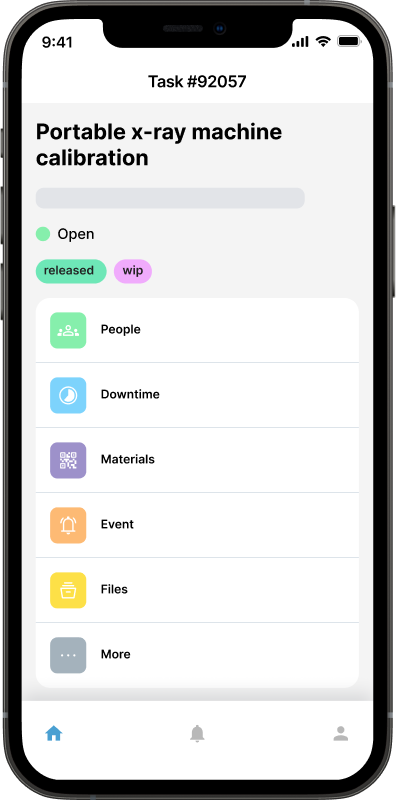
An IIoT platform might detect that Pump 3 is showing early-stage bearing wear. But what happens next? Someone needs to create a work order, assign a technician, source the replacement bearing from inventory, document the repair, and update the asset history. That is what a CMMS does.
A CMMS without predictive data still runs preventive maintenance schedules, handles reactive repairs, manages spare parts, and maintains the audit trail required for compliance. Most manufacturing facilities can operate effectively with a CMMS alone, particularly if they have a solid preventive maintenance program in place.
IIoT/Predictive Platform: Sensor data collection, anomaly detection, condition alerts, machine learning models, equipment health dashboards
CMMS: Work orders, preventive maintenance schedules, asset registry, spare parts inventory, technician assignment, compliance records, maintenance history
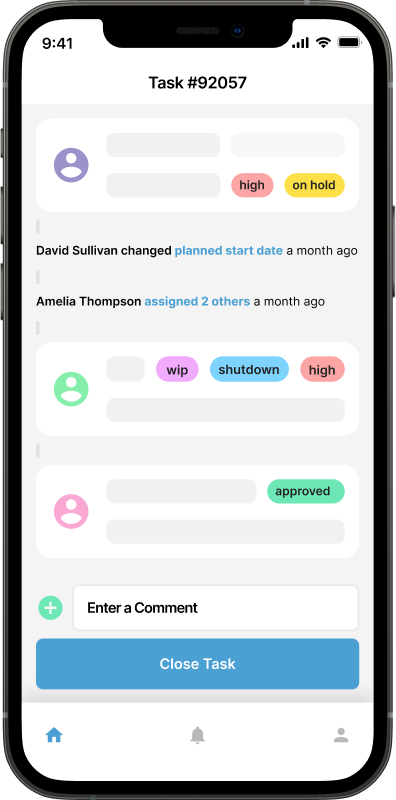
When the two are integrated, a condition alert from an IIoT platform automatically creates a work order in the CMMS, turning a signal into a scheduled repair. Learn more about how CMMS supports predictive maintenance in manufacturing.
A Practical Framework for Evaluating Industrial IoT Vendors
Whether you are evaluating Pulsar, SKF, Fluke, Tulip, Redzone, or any other industrial IoT vendor, the same questions apply. Use this framework before committing to a platform.
1. What problem are you actually solving?
Start here before looking at any vendor. Are you dealing with unexpected failures on specific high-value assets? Do you have rotating equipment (pumps, motors, compressors) where vibration or temperature anomalies typically precede failure? Or is the bigger problem that maintenance tasks are not being tracked, parts are going missing, and technicians do not have clear priorities?
If the answer is the latter, adding a predictive maintenance platform will not fix a broken process. A CMMS addresses workflow, accountability, and visibility, which is where most manufacturing maintenance teams have the most to gain first.
2. Does it integrate with your CMMS?
For any IIoT or predictive maintenance platform to deliver real value, it needs to connect to your maintenance workflow. Ask vendors directly: can alerts automatically create work orders in your CMMS? Does it have a documented API or native integration? A standalone predictive tool that sends alerts to an inbox, but requires manual entry into a separate system, creates more work, not less.
3. What does deployment actually look like?
Vibration sensors and ultrasound equipment need to be physically installed, calibrated, and maintained. Some vendors (like SKF) have a strong professional services arm and can manage this end-to-end. Others require significant internal expertise. Ask for a realistic deployment timeline and total cost of ownership (hardware, installation, ongoing calibration, and software licensing) before comparing against CMMS pricing.
4. How does the alert logic work?
Alert fatigue is real. If a platform generates hundreds of low-confidence alerts, technicians will start ignoring them. Evaluate how each vendor handles alert thresholds, false positive rates, and whether their anomaly detection models are pre-trained (faster to deploy but less precise) or trained on your specific equipment data (more accurate over time but requires a data collection period first).
5. What is the ROI case for your specific assets?
Predictive maintenance tools have a clear financial case when applied to the right assets: high-value equipment where unplanned downtime is costly, assets with detectable failure signatures, and systems where planned repairs are significantly cheaper than emergency fixes. If you cannot identify at least three to five assets that fit this profile, the investment may not pay off quickly.
When to Use IIoT Platforms Alongside Your CMMS, and When Not To
For most small-to-medium manufacturers, the right sequence is: CMMS first. Get preventive maintenance schedules running, work orders tracked, and asset history building. Once you have that foundation, and you are starting to see patterns in your failure data, then evaluate whether specific assets justify predictive monitoring investments.
IIoT platforms make the most sense when:
You have critical rotating assets (compressors, large motors, turbines) where a single unplanned failure costs significantly more than the monitoring system
Your maintenance history shows recurring failures on specific equipment that time-based PM schedules have not resolved
You have already optimized your CMMS workflows and are looking for the next layer of efficiency gain
You have the internal expertise (or budget for professional services) to manage sensor hardware and respond to alerts reliably
A well-configured preventive maintenance program within a CMMS (covering time-based, meter-based, and condition-based tasks) can deliver most of the reliability gains that predictive platforms promise, without the added hardware cost and complexity. Read about how CMMS software boosts preventive maintenance strategies.
Common Pitfalls When Evaluating Industrial IoT Vendors
Vendor evaluations in this space are often led by the vendor's most impressive demo scenario: a single asset with a perfectly detectable failure signature and dramatic downtime cost savings. Before you buy, push past the demo:
Ask for references at facilities similar to yours in size and industry, not just marquee enterprise customers.
Understand the data ownership model: can you export your sensor data and maintenance records if you switch vendors?
Clarify support responsibilities: when a sensor fails or gives a false reading, who is responsible for diagnosing and fixing it?
Map the full cost: hardware per sensor point, installation, annual software license, ongoing support, and any required professional services.
It is also worth considering the security implications of adding networked sensors to your production environment. Secure CMMS software is table stakes, but IIoT deployments also expand your network attack surface: evaluate each vendor's security posture, data encryption standards, and network segmentation recommendations.
Building a Future-Ready Maintenance Stack
The manufacturing maintenance software landscape is converging. Traditional CMMS vendors are adding IoT integrations and condition monitoring capabilities. IIoT platforms are building out work order management. The lines are blurring, and that trend will accelerate as AI-driven anomaly detection becomes cheaper and more accessible.
The smart approach is to build from the core outward: start with a CMMS that gives you clean asset data, complete maintenance histories, and reliable work order workflows. That asset data then becomes the foundation for any predictive layer you add later, ensuring condition-based alerts have somewhere actionable to land. Explore future trends in maintenance management to understand where the technology is heading.
Maintainly is designed for this kind of layered approach. It gives manufacturing maintenance teams a clean, easy-to-use CMMS foundation (with preventive maintenance scheduling, work order tracking, asset management, and inventory) without the complexity or licensing cost of enterprise platforms. As your maintenance program matures and predictive tools make sense for specific assets, Maintainly's API allows for straightforward integration with IIoT platforms.
Whether you are evaluating Pulsar, SKF, Tulip, Redzone, or Fluke, the question is not which platform wins: it is whether you have the maintenance foundation in place to make any of them work.
Further Reading

How Does CMMS Help with Predictive Maintenance in Manufacturing?
Predictive maintenance uses data analytics, sensors, and machine learning to monitor equipment and prevent failures. It detects issues early, enabling timely repairs. Unlike scheduled maintenance, it’s condition-based, saving costs. CMMS supports this by managing and optimizing maintenance processes.
Read more →
How CMMS Software Boosts Preventive Maintenance Strategies
By integrating advanced technology with maintenance operations, CMMS platforms have become indispensable tools for optimizing asset management and ensuring operational continuity.
Read more →
Future Trends in Maintenance Management: What's Next for CMMS Software?
Maintenance management is changing faster than ever. With new technologies, smarter equipment, tighter budgets, and higher expectations for uptime, maintenance teams are rethinking how they work. And at the center of all this change is CMMS software: once a clunky, confusing tool, now becoming the backbone of modern operations.
Read more →
How Secure is CMMS Software?
CMMS software holds your asset records, your maintenance history and your team's logins. Here is what protects it, what to ask a vendor, and the part of the job that stays yours.
Read more →
Why CMMS Isn't Just for Big Companies: The SME Case for Maintenance Software
The reality? CMMS was built to solve maintenance problems, and those problems don't get smaller just because a business does.
Read more →