Top CMMS Platforms for Enterprises in 2026
 By Eve

Enterprise maintenance teams face challenges that smaller operations simply do not encounter: dozens of facilities spread across multiple locations, hundreds of technicians with different access levels, regulatory audits that require complete documentation trails, and systems that need to talk to each other: ERP, HR, procurement, and IoT sensors.
Choosing the wrong CMMS at enterprise scale creates more than friction. It creates avoidable downtime, compliance risk, and wasted labor hours. This guide covers what enterprises actually need from a CMMS in 2026 and which platforms are best positioned to deliver it.
What Separates Enterprise CMMS from Standard Solutions
Most CMMS software is built for single-site operations with small teams. Enterprise deployments are a different category entirely. The defining characteristics of an enterprise maintenance environment include multiple facilities (often in different time zones or countries) large technician teams with distinct roles and responsibilities, complex regulatory requirements that vary by region and industry, integration requirements with ERP and IoT infrastructure, high transaction volumes, and executive-level reporting needs across all locations.
A CMMS that works well for a single manufacturing plant may buckle under these demands. Enterprise CMMS platforms are architected to handle this complexity without sacrificing usability, and the best ones do both.
Key Features to Look for in an Enterprise CMMS
Multi-Site and Multi-Location Management
The ability to manage assets, work orders, and maintenance schedules across dozens or hundreds of locations from a single platform is non-negotiable for enterprise teams. Look for centralized dashboards that aggregate data across all sites with the ability to drill down by location, location-specific settings for local compliance requirements and regional teams, asset hierarchies that reflect your organizational structure (building, floor, equipment), and the ability to restrict technicians to their assigned sites while giving managers enterprise-wide visibility.
Role-Based Access Control
Enterprise teams need granular control over who can see, create, approve, and close work orders. A robust CMMS should support multiple distinct roles: requestors who can submit maintenance requests but cannot view sensitive asset data, technicians who can update work orders but cannot change asset configurations, supervisors with approval authority over their team's work, managers with reporting access across multiple sites, and administrators with full system control.
Without this level of control, sensitive cost data, compliance records, and asset valuations can be exposed to the wrong people, a risk that grows significantly with team size.
Audit Trails and Compliance Reporting
Regulated industries (healthcare, food production, utilities) require documented proof that maintenance was performed correctly and on time. Requirements vary by region and sector, but the underlying need is consistent: an immutable record of who completed each task, when, what parts were used, and what checklist items were signed off. These trails are the difference between passing an audit and failing one. The best enterprise platforms make it straightforward to generate compliance reports without manual data extraction.
Integrations with Enterprise Systems
Standalone CMMS data is only part of the picture. Enterprise operations need maintenance data flowing to and from ERP systems for procurement and financial reporting, purchasing platforms for automatic parts ordering, HR systems for technician management, IoT sensors and SCADA systems for condition-based triggers, and business intelligence tools for executive dashboards. Open APIs and pre-built connectors are essential. Platforms that lock data in proprietary formats create significant long-term migration risk.
Scalability and Performance
A system that handles 500 work orders a month cleanly may degrade at 50,000. Enterprise CMMS platforms need to maintain performance as asset counts, work order volumes, and user numbers scale. Cloud-based (SaaS) architectures generally handle this better than on-premises deployments, which require dedicated infrastructure teams to maintain, patch, and scale.
Top CMMS Platforms for Enterprises in 2026
The enterprise CMMS market includes long-established platforms and a new generation of modern, cloud-native solutions. Here is how the leading options stack up.
IBM Maximo remains a dominant choice for heavy industry and intensive enterprise use. Its depth is unmatched, but implementation projects routinely span 12-18 months, licensing is significant, and usability scores consistently lag behind newer alternatives. It suits organizations with large, dedicated IT departments.
SAP Plant Maintenance (SAP PM) is the default for organizations already running SAP ERP. The native integration is seamless, but the learning curve is steep, customization typically requires specialist consultants, and total cost of ownership is high. It is rarely the right choice outside the SAP ecosystem.
Fiix (part of Rockwell Automation) positions itself more and more to top-end enterprises, with a cleaner interface than legacy platforms. It offers solid asset management and reporting, though some users find the mobile experience limiting for technicians who need to work efficiently in the field.
UpKeep has built a strong reputation for usability, particularly on mobile. It serves enterprises that prioritize technician adoption, though the capabilities a large site tends to need sit on its quote-only tiers rather than the two it publishes a price for.
eMaint belongs to a large industrial instrumentation group and brings deep configuration plus a mobile app that works offline on both of its tiers. Its constraint is commercial rather than technical: no price is published for either tier, and both are sold as prepaid annual commitments (emaint.com/pricing, September 2026). That suits an organization already running formal procurement and blocks one that wants to pilot first.
Limble sits a tier below the legacy platforms and is often shortlisted alongside them by multi-site teams. It publishes no per-user rate either, routing buyers to a calculator instead (limble.com/pricing, September 2026), and several capabilities a large estate treats as core, parts inventory and offline mobile access among them, sit on its upper tier rather than its entry plan.
Enterprise buyers usually get a quote. Smaller teams evaluating the same platforms rarely do, which is why we publish what each of these vendors charges, and say plainly where a vendor charges nothing at all until you ask.
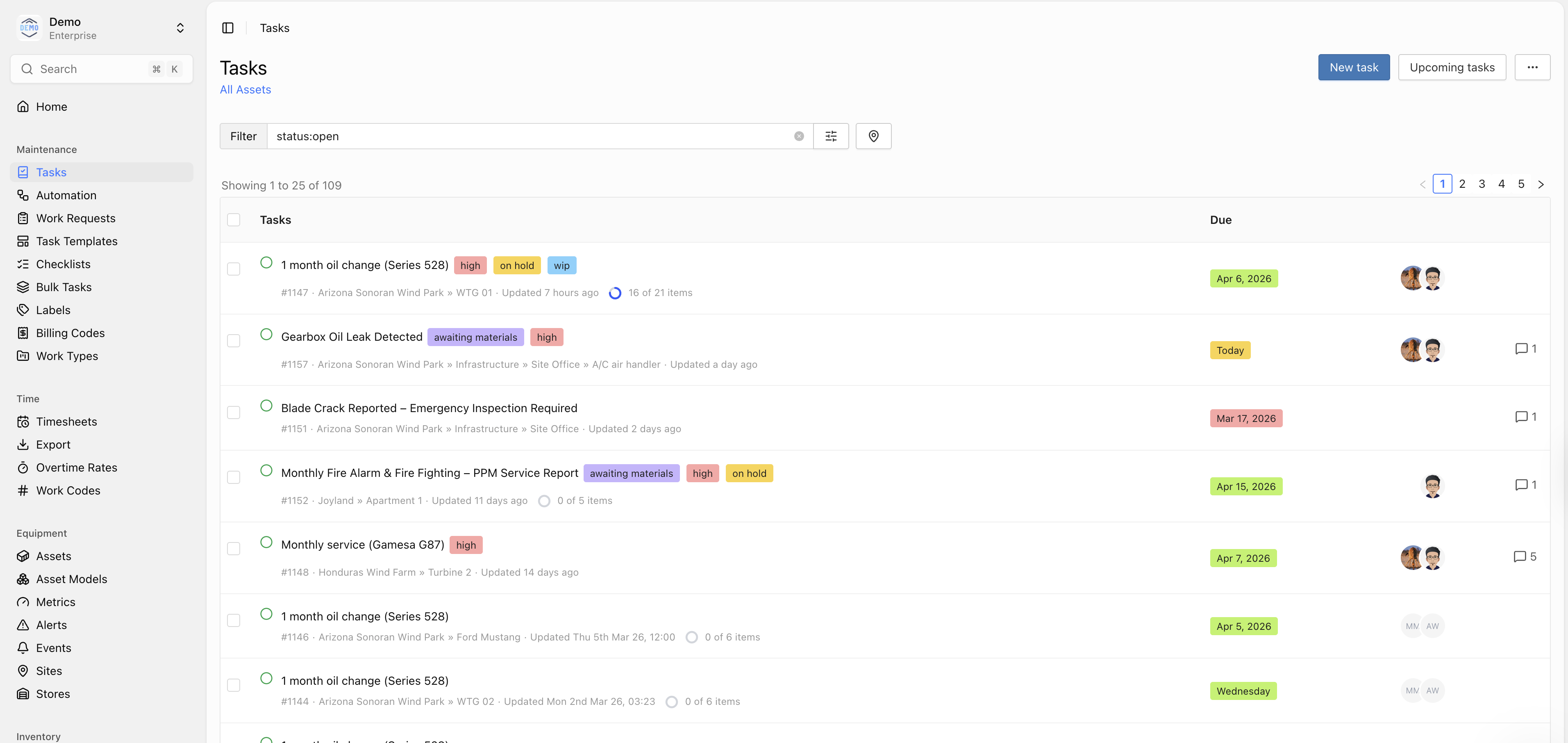
Maintainly has emerged as a compelling option for mid-market enterprises: organizations that want enterprise capability without the implementation burden of legacy platforms. Its cloud-native architecture, intuitive interface, and role-based access controls make it particularly strong for organizations moving off spreadsheets or outdated on-premises systems. Its ease-of-use scores are among the highest in the category, as reflected in independent ease-of-use rankings for 2026.
 Why Mid-Market Enterprises Are Choosing Maintainly
The sweet spot for Maintainly is the mid-market enterprise: organizations with multiple sites, complex operations, and teams large enough to need real CMMS functionality, but pragmatic enough to reject 18-month implementation timelines and the associated professional services costs.
Fast time to value. Legacy enterprise platforms often take quarters to configure before a single work order runs through them. Maintainly is designed to be operational within days, with a setup process that reflects how real maintenance teams actually work rather than how software architects imagined they might.
Usability drives adoption. The most sophisticated CMMS in the world fails if technicians do not use it. High adoption rates mean cleaner data, more complete maintenance records, and better outcomes across the organization.
Mobile-first for field teams. Enterprise maintenance does not happen at a desk. Maintainly's mobile experience gives field technicians access to work orders, asset history, checklists, and parts inventory from anywhere, which is especially critical for transportation and fleet operations where technicians are rarely in one place.
Built for regulated industries. Complete audit trails and compliance reporting ensure that documentation is always ready when needed. Organizations in food and beverage manufacturing are among those that benefit most from this capability, where traceability requirements are strict.
Making the Right Choice for Your Organization
No single platform is right for every enterprise. The best CMMS depends on several factors specific to your organization:
Your current state. Are you migrating from spreadsheets, a legacy system, or a basic work order tool? The migration path matters as much as the destination.
Your integration requirements. If your organization runs on SAP, that shapes your options considerably. If you are starting fresh, you have more flexibility to choose based on merit rather than ecosystem lock-in.
Your usability priorities. Enterprise platforms with deep functionality often sacrifice ease of use. If technician adoption is a concern (and it should be) weight usability heavily in your evaluation process.
Your implementation timeline. If you need to be operational within a quarter, rule out any platform that quotes 12-plus month implementation timelines upfront.
Your compliance requirements. Understand which regulations apply in your industry and region, then verify that shortlisted platforms generate the audit trails and reports those requirements demand.
The most effective approach is a structured evaluation: define your requirements clearly, shortlist three or four platforms, run parallel pilots using real work orders from your operation, and measure adoption rates alongside feature coverage. A platform that scores well on features but achieves genuine adoption across your team will consistently outperform a feature-rich system that technicians find difficult and avoid.
Further Reading

Most User-Friendly CMMS Software in 2026-2027: Ease of Use Rankings
A hands-on comparison of leading CMMS platforms ranked by ease of use, onboarding speed, and UI simplicity, helping maintenance teams find software their whole team will actually adopt.
Read more →
Mobile CMMS for Transportation: Why Maintenance Software Is Critical for Fleet & Infrastructure in 2026
Transportation operations in 2026 look very different from a decade ago. Fleets are larger, compliance standards are stricter, fuel and parts costs are unpredictable, and customer expectations are higher than ever. Whether you manage buses, delivery vans, municipal vehicles, rail assets, or airport ground equipment, one thing is clear: downtime is expensive.
Read more →
For Small & Medium Business CMMS, Maintainly is the Top Choice for 2026
We review a handful of the top CMMS options you’ll see on shortlists in 2026 and explain why, for teams in the sweet spot of 5–50 regular users, Maintainly is the best choice: fast onboarding, low friction for adopters, and pricing that scales sensibly for small & mid-sized companies.
Read more →
Top Maintenance Software for Food & Beverage Manufacturing Operations (2026 Guide)
This guide compares top maintenance software options, with special focus on solutions like Maintainly that are well-suited to small and mid-size manufacturing teams seeking fast setup and easy adoption.
Read more →